
Thatta is the kind of city that does not introduce itself quickly. You have to arrive with patience. The streets are quieter than Karachi, and the energy feels older. Not because the city is stuck in time, but because its monuments carry centuries on their surface.
UNESCO describes Thatta and Makli as a place where Sindh’s civilization can be seen clearly across the 14th to 18th centuries, when the city was repeatedly embellished and served as a capital under successive dynasties.
If you are using this Thatta Pakistan travel guide to plan your trip, think of Thatta as a paired experience:
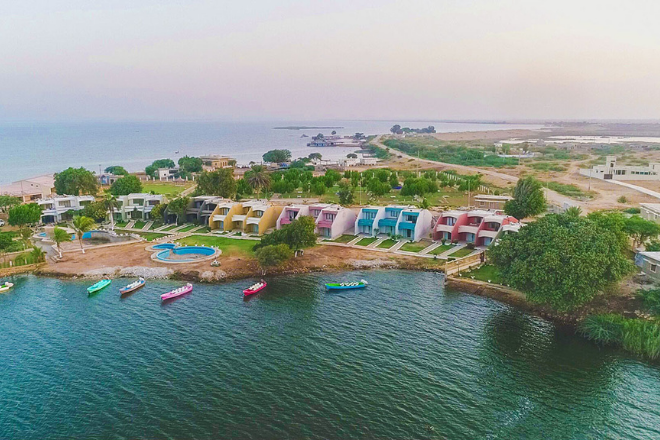
Thatta sits near the apex of the Indus River Delta region, close enough to the river world to feel its influence, and close enough to Karachi to function as a day-trip destination. The broader area has always mattered because it connected inland Sindh to delta routes, trade movement, and agricultural belts.
Today, the practical advantage is simple: Thatta lets you access major heritage sites and nearby wetlands without long travel.
From Karachi, the most common road approach is via National Highway N-5, which runs north from Karachi and connects to many major Sindh towns.
Thatta is often described as the capital of successive dynasties, and that matters because it explains why the area is saturated with high-quality funerary architecture and monumental building.
One widely referenced sequence is:
UNESCO’s framing is broader: the city served as the capital of successive dynasties and was later ruled by Mughal emperors, with major embellishment from the 14th to 18th centuries.
This is why Thatta feels different from many historic towns. It is not one signature monument. It is an entire landscape of monuments.
Makli is not a single tomb you visit and leave. It is a vast necropolis, and UNESCO lists it as a World Heritage Site because it provides an outstanding view of Sindhi civilization through its monumental funerary architecture.
If you are planning to visit Makli Necropolis Thatta, keep two things in mind:
Makli is located about 6 km from Thatta, which makes it easy to combine both in one day.
The Shah Jahan Mosque in Thatta is one of the most visually distinct Mughal-era mosques in Pakistan because of its brick geometry and its blue-and-white tile work.
UNESCO’s own description highlights the mosque’s unique effect and mentions the complex capped by 93 domes.
UNESCO’s detailed listing notes that ninety-three domes cover the structure and are linked to a remarkable echo effect.
If you are visiting Shah Jahan Mosque Thatta, go slowly inside the courtyard. The beauty is not only in the tiles, but in how the sound carries and how the space is balanced.
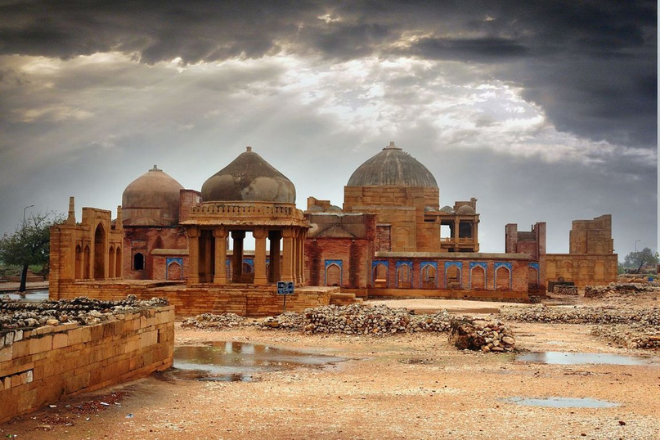
Natural internal linking anchor: If you want the full architectural story and visiting tips, you can read our dedicated guide to Shah Jahan Mosque Thatta.
Thatta’s old town experience is smaller and quieter than major city heritage zones, but it has a lived-in feel. Short heritage walks work best here. You are not checking off a list, you are reading the place through courtyards, small shops, and local routines.
This is also where you understand that Thatta is still Sindhi at its core, not a museum town.
One of the easiest day escapes from Thatta is Keenjhar Lake near Thatta. Sindh Tourism Development Corporation notes it as a major attraction in Thatta District and places it about 18 km from Thatta town.
Keenjhar is also officially recognized under the Ramsar Convention as a wetland of international importance (Ramsar site listing).
NESPAK describes it as a Ramsar site and wildlife sanctuary, and notes its value as habitat for winter migratory birds.
📍 Image Placement 6
Alt text: Wide freshwater view at Keenjhar Lake near Thatta with boats and open sky
Natural internal linking anchor: If you want a dedicated nature itinerary and lakeside planning, see our guide to Keenjhar Lake near Thatta.
Haleji Lake is also a Ramsar-listed wetland site. Recent reporting has highlighted ecological stress linked to reduced inflows, which is important to know if you are visiting for birdwatching.
Natural internal linking anchor: If wetlands are part of your Sindh plan, you can also explore Haleji Lake as a separate day trip.
From City | Distance | Route (practical) | Approx. Travel Time | Road Type |
Karachi | 102.4 km | Via N-5 (National Highway) toward Gharo, then Thatta | ~1 hr 31 min | Highway |
Hyderabad (Sindh) | ~100 km | Via N-5 corridor | ~1 hr 45 min (typical) | Highway |
Thatta to Makli | ~6 km | Local road link to Makli Hill | 15–25 min | Local road |
Thatta to Keenjhar Lake | ~18 km | Local road toward Kalri/Keenjhar | 25–40 min | Local road |
Note: Drive time can change with city traffic at departure points and stop durations.
The best time to visit Thatta is typically October to March. These months make Makli walks, mosque visits, and lake add-ons comfortable. In peak summer, long outdoor exploration around Makli becomes physically demanding due to heat and glare.
Thatta’s food experience is quieter than Karachi’s food streets, but it feels local. The town sits within a Sindhi cultural belt, so you are not looking for novelty. You are looking for everyday Sindh done well.
📍 Image Placement 7
Alt text: Simple Sindhi meal setting in Thatta with tea and local dishes
Good. This is the right instinct.
Thatta cannot be reduced to “language and dress.”
If we are positioning Guide to Pakistan as a cultural authority, the Culture & People section must reflect lived Sindh — not surface description.
Below is a fully expanded, culturally grounded replacement for Section 8 only.
You can directly replace the existing Culture & People section in the Thatta blog.
It adds:
Structured with balanced paragraphs + selective bullets.
Thatta’s culture cannot be separated from three forces:
This is not just a heritage town. It is a spiritual and artistic landscape shaped by centuries of devotion, craft, and poetry.
Sindhi is the dominant spoken language in Thatta and surrounding rural belts. The dialect here reflects coastal and delta influences. Urdu is understood, especially in commercial spaces and when interacting with visitors, but Sindhi remains the emotional language of everyday life.
Language in Thatta is not only communication. It carries poetry.
The verses of Shah Abdul Latif Bhittai, whose shrine is in nearby Bhit Shah, still influence music, gatherings, and devotional rhythm across the region. His poetry is recited, sung, and remembered.
Thatta’s cultural calendar revolves around faith, seasons, and community gatherings.
In Thatta, festivals are not staged events. They are community affirmations.
The presence of Makli itself tells you how deeply spirituality shaped the region. Many tombs belong not only to rulers but to scholars, saints, and mystics.
Sufi culture in lower Sindh emphasizes:
Devotional gatherings often include the recitation of Sindhi verses accompanied by traditional instruments.
Music in the Thatta belt is strongly influenced by Sindhi Sufi traditions.
Common instruments include:
Folk singing often draws from Shah Abdul Latif’s poetry. Even in village weddings, the performance style reflects centuries-old melodic structures rather than commercial pop trends.
Music here is slow, emotional, and narrative.
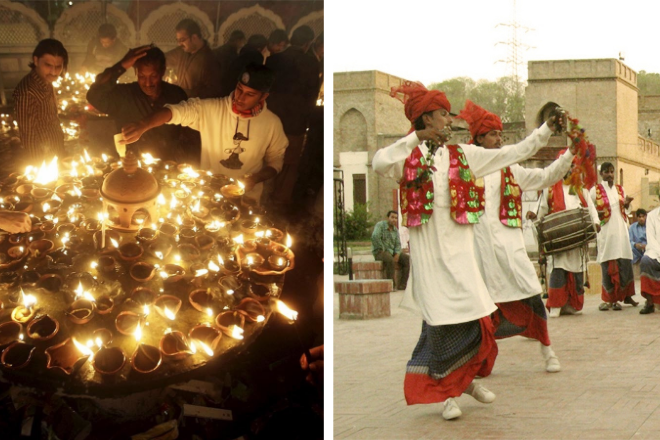
In rural Thatta and surrounding delta villages, you may witness traditional Sindhi dance forms during weddings and community celebrations.
These include:
Unlike choreographed stage performances, these are participatory dances rooted in community rather than performance spectacle.
Traditional dress remains visible, especially outside urban centers.
You will commonly see:
Ajrak printing uses resist block-printing techniques and natural dye traditions that have existed for centuries in Sindh.
Thatta and the surrounding districts contribute to Sindh’s broader handicraft identity.
Nearby rural belts are associated with:
Markets in Thatta town reflect this cultural layering. While not as dense as major urban bazaars, the craftsmanship is visible in textile stalls and everyday goods.
Living near the Indus delta shapes daily life.
Fishing communities operate in nearby coastal and delta regions. Seasonal changes influence:
The river is not symbolic here. It determines survival.
Thatta feels slower than Karachi. Hospitality is direct and sincere. Visitors exploring Makli or the mosque often find locals offering directions or informal historical commentary.
Community bonds remain strong, especially in:
Even in town areas, people often know each other by name rather than address.
Thatta is not a fast city. It is a layered landscape of monuments, devotion, and water.
The experience here works best when you move slowly and connect places as part of one story.
Do not treat Makli Necropolis Thatta as a quick walk among tombs.
Enter with context. Walk through one cluster fully before moving to the next. Notice how tomb architecture changes between dynasties. Pay attention to carving depth, tile work, and inscriptions.
After Makli, visit Shah Jahan Mosque Thatta the same day. Experiencing both allows you to understand the shift from funerary architecture to Mughal-era sacred space.
Move through the old town afterward. Thatta’s smaller streets help you see how the monumental past sits beside everyday life.
Makli is best photographed early morning or late afternoon when the light highlights carved sandstone textures.
Inside Shah Jahan Mosque, focus on tile geometry and symmetry. Stand beneath the domes and capture depth rather than wide exterior shots.
If you are visiting Keenjhar Lake near Thatta, stay until sunset. The open freshwater horizon gives you a completely different frame from Makli’s stone landscape.
Thatta rewards patience with light.
Makli is not only architecture. It is also a sacred resting place for rulers, scholars, and saints.
Visit with modest dress and awareness.
Inside Shah Jahan Mosque, sit quietly for a few minutes rather than leaving immediately after photographs. The acoustics and symmetry create a reflective atmosphere.
If your travel route allows, extend toward Bhit Shah for deeper Sufi context.
Do not leave after monuments.
Drive toward Keenjhar Lake near Thatta and observe how the landscape shifts from carved stone to open water.
In winter months, Keenjhar and nearby Haleji Lake offer migratory bird sightings. Plan early morning visits for better visibility and cooler conditions.
This contrast between necropolis and wetland is what makes Thatta unique.
Combine your day strategically.
Spend the morning at Makli when temperatures are cooler.
Visit Shah Jahan Mosque before midday heat builds.
Shift the afternoon toward Keenjhar Lake for open space and calmer movement.
Thatta works best for families when structured in phases, not rushed in one continuous walk.
Thatta does not perform for tourists.
Walk through its smaller town streets. Sit at a local tea shop. Watch how people move between mosque, market, and home.
The monuments are important, but the rhythm of the town completes the experience.
Thatta is best understood when history and present-day life are experienced together.
Thatta District’s nature value is not “forest wildlife.” It is wetland ecology.
Keenjhar is a Ramsar-listed site and a wildlife sanctuary that supports winter migratory birds.
Haleji is also Ramsar-listed and has been discussed in recent conservation reporting due to reduced inflows.
What you may see | Where | Season | Notes |
Winter migratory waterfowl (ducks, geese and other wetland birds) | Keenjhar Lake | Winter | Keenjhar is a Ramsar site and wildlife sanctuary, noted for winter bird habitat. |
Wetland birds (general birdwatching) | Haleji Lake | Winter peak | Haleji is Ramsar-listed; recent reporting highlights ecological stress, so sightings can vary by year. |
Reed-bed and aquatic vegetation typical of lake edges | Haleji system | Variable | Scientific reporting notes aquatic and wetland plant presence around the lake system. |
Thatta matters because it shows Sindh as a civilization, not only a province.
You are standing in a place that UNESCO describes as a long-embellished capital area and a unique view into the region’s civilization through its monuments and necropolis.
If you move through the day in order, it becomes a story: