
Hazuri Bagh is a historic garden located in the heart of Lahore, positioned between Lahore Fort and Badshahi Mosque. Unlike large landscaped gardens, Hazuri Bagh functions as an open courtyard that visually connects two of the city’s most important monuments.
The garden is best known for the Hazuri Bagh Baradari, a white marble pavilion that stands at its center. Today, Hazuri Bagh is less about structured walking and more about pause. Visitors come here to sit, observe, take photographs, and absorb the scale of surrounding architecture.
Hazuri Bagh is not a destination for long stays. It is a transitional space, meant to be experienced slowly as you move between Lahore Fort and the mosque.
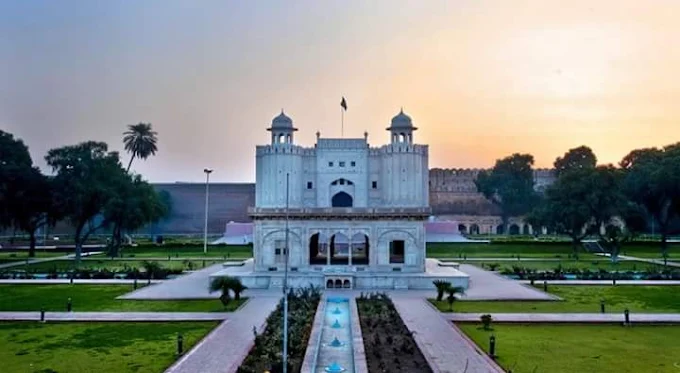
Hazuri Bagh was developed during the Sikh period, under the rule of Maharaja Ranjit Singh. The central baradari was constructed to celebrate the acquisition of the Koh-i-Noor diamond, making the space historically significant beyond Mughal-era associations.
The baradari originally featured intricate marble work, though parts were damaged during the colonial period. Despite this, it remains an important example of pavilion architecture and continues to define the identity of Hazuri Bagh.
The surrounding garden layout has changed over time, but the open nature of the space has been preserved.
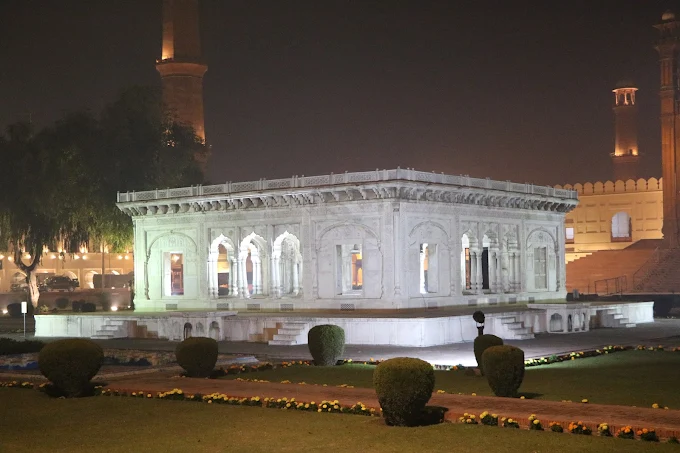
The central baradari is the main landmark. Built from white marble, it was designed as a viewing pavilion rather than a residence. Visitors can walk around it, observe details, and photograph it from multiple angles.
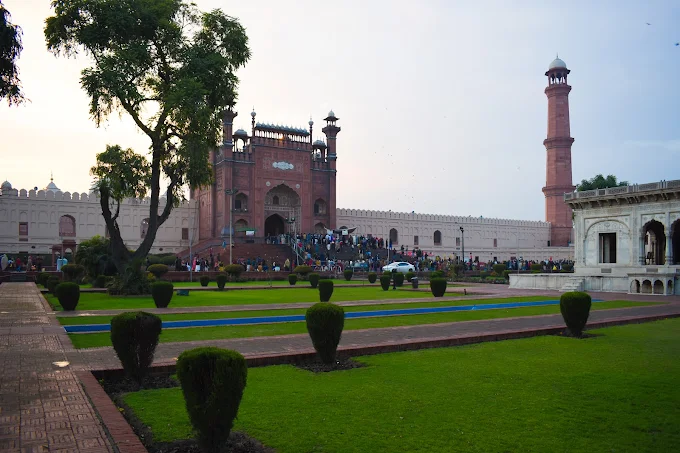
Hazuri Bagh is largely an open lawn with pathways around the pavilion. Visitors often sit on the grass, pause between monument visits, or wait for prayer times at the Badshahi Mosque.
This open layout allows clear sightlines to surrounding landmarks.
From Hazuri Bagh, visitors can see:
This makes the garden a strong visual and photographic midpoint.
The garden is often filled with pigeons, especially during mornings and evenings. This creates a lively atmosphere and is popular with photographers.
Local visitors, families, and students use the space informally rather than as a formal park.
Access point: Lahore
Hazuri Bagh is located within Lahore’s Walled City.
Access is primarily on foot once inside the Walled City. Vehicles are parked outside designated zones.
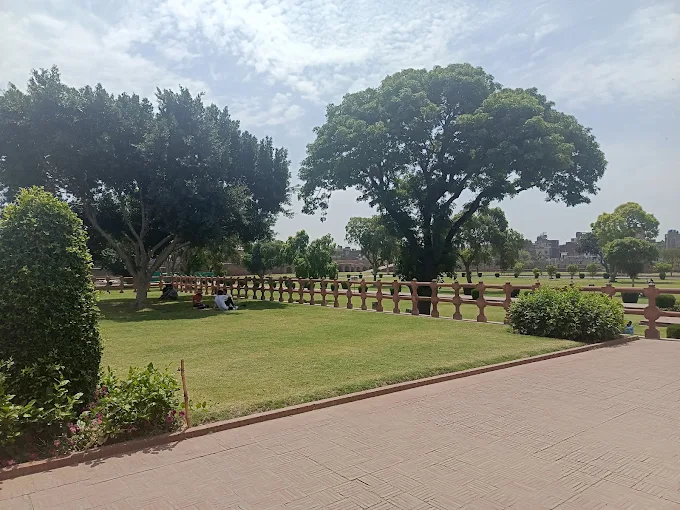
Best time to visit: October to March
Early mornings and late afternoons are ideal due to softer light and fewer crowds. Midday can be hot in summer due to limited shade.
Hazuri Bagh is a shared public heritage space. Visitors should maintain respectful behavior, especially during prayer times at the nearby mosque and official ceremonies in the area.